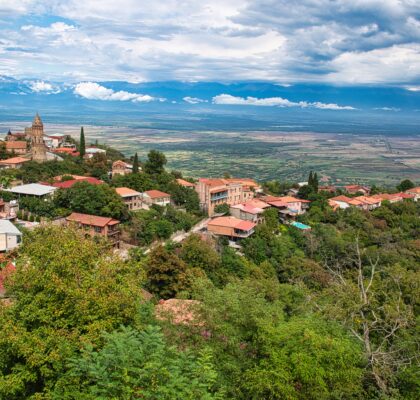
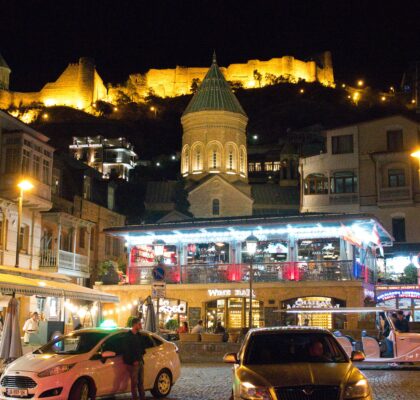
- Tbilisi, Georgia, Sept 2022
- More Tbilisi, Georgia, Sept 2022
- Kakheti Wine Region, Eastern Georgia, Sept 2022
- Western Georgia, Sept 2022
Western Georgia, Sept 2022
After a few wonderful days in the Kakheti wine region, we were back in Tbilisi for the night, and next day we loaded up the car and drove out to explore Western Georgia.
First stop was Mtskheta, barely 30 minutes north-west from Tbilisi, at the confluence of the Mtkvari (Kura) and Aragvi rivers. Mtskheta is the old capital of Georgia — one of the oldest continuously inhabited cities in the country, settled around the 5th century BC, and Georgia’s capital for almost a thousand years before the capital moved to Tbilisi. Today the whole town is a UNESCO World Heritage site, and as the birthplace and one of the most vibrant centers of Christianity in Georgia, Mtskheta was declared the “Holy City” by the Georgian Orthodox Church in 2014
At the center of the old town stands the Svetitskhoveli Cathedral (Cathedral of the Living Pillar), a huge 11th century cathedral built, according to legend, over the spot where Christ’s robe was buried. Unfortunately, the cathedral itself was closed the day we visited, with its dome under restoration — so we admired it from the outside.

The area around the cathedral is a lively tourist zone, with a market street of stalls selling churchkhela (walnuts threaded on a string and dipped in thickened grape must), local jewelry, spices, honey, and the ever-present bottles of home-made chacha).


We then drove about an hour west to Gori; a city that would be quite unremarkable except for one historical fact: Joseph Stalin, the Soviet Premier & dictator, was born & raised here in 1878. The tiny two-room wooden house where he was born has been preserved in the main square, protected under a purpose-built marble pavilion, with the large Stalin Museum behind it.


The museum itself is large and nicely laid out but reads more like a shrine than a critical history: portrait after portrait of Stalin as the young revolutionary, the wartime leader, the statesman at Yalta with Churchill and Roosevelt; his pipes, his desk, his overcoat. There is very little about the Gulag or the purges. The local boy made it big, and Gori has not quite let go of him; it’s complicated. Behind the museum, on its own piece of track, sits his personal armored railway carriage — the one he used to get around, including to the Tehran and Yalta conferences, since he did not like flying. Armored, bulletproof glass and all.

Then it was time for lunch, on a very nice outdoor patio in the city center; salads, Georgian starters and cold drinks in the warm afternoon sun.

We continued driving southwest, leaving the flat Kartli plain and entering the narrowing, forested gorge of the Mtkvari river, arriving in Borjomi late afternoon. Borjomi is a spa town in the grand old European tradition — 19th century Russian aristocrats came here to “take the waters” of the natural spring; the Romanovs had a summer residence here, and Borjomi mineral water has been bottled and exported since the 1890s — at its Soviet peak, hundreds of millions of bottles a year. Because of the supposed curative powers of the area’s mineral springs, it is a frequent destination for people with health problems. We stayed at the Crowne Plaza Borjomi; a very nice hotel set above the river, complete with a spa fed by the natural mineral baths — although we discovered the famous water is not hot, only warm 🙂. Dinner was at the Café Tourist in old town Borjomi; simple and good for Georgian soups and classics-recommended by our hotel staff. Some scenes in Borjomi below.

Video of the Borjomi town and the mountainous backdrop outside our hotel. Note the river bridge design
Next day, after breakfast, we walked to Borjomi’s famous Central Park, which follows a tributary stream deep into the forested valley. Just inside the park is the mineral spring pavilion, where the Ekaterina Spring — discovered in 1841 by Russian soldiers — flows year-round. A tap lets you fill your cup straight from the source. The water comes out warm, slightly fizzy, and tastes of minerals; we drank several cups; hopefully helpful for the gut :). We then hiked further up the valley in the woods, to the waterfall at the head of the park; a very pleasant walk among tall conifers with the stream rushing alongside.


On the way back, we checked out the small market stalls near the park entrance — dried herbs, honey, jams (including the famous local pine-cone jam), and of course, more churchkhela.


Dinner that evening was at a small family restaurant in town: khinkali (the famous Georgian dumplings, filled with spiced meat), fresh trout, and potatoes. The khinkali was not particularly tasty for me; maybe I should have tried the fish or vegetable version but the meat version is the most commonly eaten type.

Khinkali is a typical Georgian dish in this area; boiled dumplings typically filled with juicy meat filling seasoned with lots of onion and fresh cilantro, with ground black pepper sprinkled on top — Correct khinkali eating technique, as taught to us by a local: hold it by the twisted knob on top, bite a small hole, suck out the hot broth, then eat the rest — and never, ever use a knife and fork 🙂. You live and learn 🙂 🙂 .
Next day, after breakfast, we drove about 45 minutes south to Akhaltsikhe. Some scenes along the way.


We stopped when we saw this family parked by the roadside and picnicking in the middle of nowhere. And since the young man of the family knew some English, he asked if we needed any help. We told him & the family that we had just stopped out of curiosity to see what they were doing here. They invited us to join their picnic, and told us that they live in Tbilisi, and have a plot of land here, where they were harvesting potatoes. They offered us potatoes to take with us, but we declined politely. So nice of them.


In Akhaltsikhe (“new castle” in Georgian), we stopped to visit the Rabati Castle; a large fortress complex, which passed between Georgian, Ottoman and Russian hands over the centuries, & has been very well restored to its original condition. Inside the walls are the fort and citadel, an Orthodox cathedral, a mosque, and a madrassa built by the Ottoman governor (Haji Ahmed-Pasha Jaqeli) in 1752 — fashioned, with its dome and arcades, after the Hagia Sophia in Istanbul. Impressive place.


Views from the Rabati Castle of its grounds


We had read that there was a synagogue in town and only 1 Jewish family left here who still maintained and used the synagogue. So, after a trout lunch at Restaurant Mimino (& homemade chacha 🙂 ); we drove to where the synagogue was supposed to be. We found it but it was locked. While we were peeping into the grounds at the locked gate, a nice gentleman came by and indicated (no English) that he would call the caretaker and gestured us to wait. Sure enough, a short while later, a young man came around and opened the synagogue for us to visit. Very nice hospitality, with no English.


From Akhaltsikhe we drove on south towards Vardzia. The landscape changes completely here — you climb onto the high Samtskhe-Javakheti plateau, open and almost treeless, with medieval stone churches appearing beside the road in the middle of nowhere, and volcanic peaks growing more dramatic as you approach the Mtkvari gorge.

The demographics here are approx. half Armenian and half Georgian speakers, as this province borders Armenia and Turkey. We passed a large roadside village statue of Queen Tamar, the celebrated medieval ruler who completed Vardzia; a hint of what was coming. She was actually officially called King Tamar 1.

We arrived at the Vardzia Resort, our base for the next 2 nights, set directly across the gorge stone cliffs; a very nice property. We had dinner at the hotel, and called it a night.
First evening at Vardzia Resort
Next morning, after breakfast, we crossed the gorge to visit the amazing cave city itself. Some history: Vardzia was carved into the volcanic tufa cliff in the late 1100s, begun by King Giorgi III and completed by his daughter Queen Tamar, during Georgia’s medieval Golden Age.
So why carve an entire city into a mountain? Georgia at the time was a rich Christian kingdom sitting on the crossroads of empires, and everybody wanted a piece of it. The Seljuk Turks had swept through the Caucasus in the previous century, devastating the lowland towns, and the threat of Muslim armies invading from the south and east was constant. So Giorgi III commissioned Vardzia as a hidden fortress-monastery: a place where the royal court, the army, and much of the population of the region could disappear into the mountain if the lowlands fell. The location was chosen carefully — deep in the Mtkvari gorge, guarding the route towards Armenia and Persia, with the caves carved behind the cliff face and invisible from the valley below. At its height it had some 600+ rooms on 19 levels, connected by tunnels, able to shelter several thousand people. And it worked — Vardzia sheltered the region when the Mongols overran Georgia in the 13th century, ending the Golden Age. But nature did what armies could not: in 1283, a massive earthquake sheared off a third of the cliff face, exposing the hidden city — the open honeycomb of caves you see today. Later still, in 1551, the Persian (Safavid) army of Shah Tahmasp I sacked the monastery and carried off its treasures, and the region then fell to the Ottomans — after which Vardzia lay largely abandoned for centuries.
180 degree views of Vardzia Valley & Cave city

We spent the morning exploring the tunnels, staircases and caves — and it is astonishing how complete a city this was. There is the Church of the Dormition with its 12th-century frescoes of Giorgi III and Tamar, a refectory, a pharmacy, living quarters, stables, water cisterns and food storage rooms, and — this being Georgia — proper wine cellars, with dozens of qvevri pits carved right into the rock floors. Even in a fortified mountain refuge, the Georgians made sure the wine supply was secure 😊. Water was Water was supplied via 4 km long aqueduct from Upper Vardzia village. A small community of Eastern Orthodox monks still lives here; the monastery was reactivated in 1988.

View of the caves from the cave face
Some views inside the rock cave city


Amazing place; well worth visiting.

After an amazing morning here, we went back to the hotel and chilled by the poolside for the rest of the evening.

Next morning, after a hearty breakfast-for-the-road from the hotel, we started the drive back to Tbilisi — deliberately taking a different route, east across the high plateau. This drive took us through multiple micro-zones of landscape: open steppe at 1,800 meters with shallow lakes and haybales, then bare volcanic hills, then green river valleys, then forested gorge — each one different from the last, sometimes within twenty minutes of each other. Along the way, shepherds moved their flocks across the grasslands, and small stone villages appeared with their hay stacked for the winter.


Driving back to Tbilisi from Vardzia — open steppe, volcanic cones, rolling hills and shepherds tending to their cows, sheep, goats with horses and sheep dogs

Lunch on the way back was one of the best meals of the trip — at a very nice small restaurant in a little village in the middle of rolling green hills: fresh trout, grilled whole, with fries, bread, salads and a cold drink. Simple, perfect, and in a setting no city restaurant could match.


Back in Tbilisi; it was back to the Sheraton for one last night in Tbilisi, before flight back to Dallas via Doha.
Some musings on Georgia, as this was the end of our Georgian journey: over these weeks, Georgia showed us an amazing variety — from the sulphur baths, old churches and lively streets of Tbilisi, to the vineyards, qvevris and vineyards of Kakheti, to the old capital Mtskheta, Stalin’s Gori, the spa town of Borjomi, the restored Rabati Castle, and the astounding cave city of Vardzia. What stood out everywhere was the kindness and hospitality of the Georgian people — total strangers who invited us into their homes, fed us, and sent us off with fruit from their orchards; it upheld our faith in the goodness of humanity.
The 5 senses? The sights were spectacular — ancient churches and cave cities, vineyards heavy with harvest grapes, and the Caucasus mountains on every horizon. The sounds — Orthodox chanting drifting out of 1,000-year-old churches, rushing mountain streams, sheep bells on the high plateau, and lively Georgian chatter around every supra table. The smells — fresh bread coming out of the tandoor ovens, pine forests in Borjomi, and the earthy waft of fermenting grapes in every marani. The tastes — khinkali, khachapuri, fresh trout, walnut-rich starters, amber wines from the qvevri, and the occasional (obligatory) chacha 😊. And touch — the warm mineral water at the Borjomi spring, and the cool, smooth stone of Vardzia’s staircases, polished by 800 years of feet before ours. Georgia fills up all the senses; it is still inexpensive, uncrowded, safe, and packed with history, natural beauty with wonderful food & wine. Well worth visiting.
Next is Saudi Arabia, starting with Jeddah
Our trip so far

- 2022
- Akhaltsikhe
- Borjomi
- Borjomi mineral water
- Cathedral of the Living Pillar
- Cave City
- Central Park
- chacha
- Church of Dormition
- churchkhela
- Ekaterina Spring
- Firuza building
- Georgia
- Gori
- Joseph Stalin
- Jvari Monastery
- khinkali
- King Tamar
- King Tamar 1
- Mtkvari
- Mtkvari Gorge
- Mtskheta
- Queen Tamar
- Rabati Castle
- Samtskhe-Javakheti
- Stalin
- Svetitskhoveli Cathedral
- Vardzia
- Vardzia Cave City